 Applying TDD When Extending Features — TDD with Spring Boot, Part 12
📅
Add a discount policyAutomatically discount products priced at 30,000 KRW or more by 1,000 KRW. (Example: enter 35,000 KRW -> store 34,000 KRW.)
if statement in the Product object.
Even though the discount logic does not exist yet, we first write a test that insists the discount should be applied.package com.example.tdd_study.product;
import org.junit.jupiter.api.Test;
import static org.assertj.core.api.Assertions.assertThat;
class ProductTest {
@Test
void 가격이_3만원_이상이나면_1000원_할인된다() {
// given
String name = "비싼 커피";
int originalPrice = 35000;
int expectedPrice = 34000; // 1000원 할인 기대
System.out.println("[Test Start] 할인 정책 테스트 시작");
System.out.println("입력 가격: " + originalPrice);
// when
Product product = new Product(name, originalPrice);
// then
System.out.println("검증 결과: 실제 저장된 가격 = " + product.getPrice());
assertThat(product.getPrice()).isEqualTo(expectedPrice);
System.out.println("[Test Pass] 테스트 성공! 할인이 정상 적용됨");
}
@Test
void 가격이_3만원_미만이면_할인이_없다() {
// given
int price = 20000;
// when
Product product = new Product("일반 커피", price);
// then
assertThat(product.getPrice()).isEqualTo(price);
}
}35000 KRW is stored unchanged.
The console prints 검증 결과: 실제 저장된 가격 = 35000 (validation result: actual stored price = 35000), and the test reports that it differs from the expected value, 34000.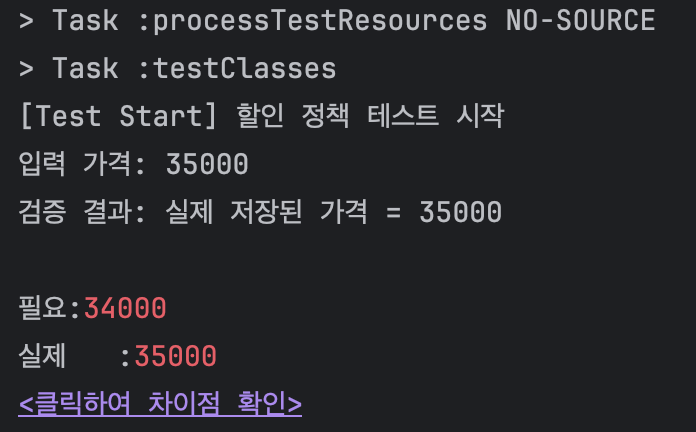
Product class to make the test pass.
Inside the constructor, we check the price and apply the discount.package com.example.tdd_study.product;
import jakarta.persistence.*;
import lombok.AccessLevel;
import lombok.Getter;
import lombok.NoArgsConstructor;
import org.springframework.util.Assert;
@Entity
@Table(name = "products")
@Getter
@NoArgsConstructor(access = AccessLevel.PROTECTED)
public class Product {
@Id
@GeneratedValue(strategy = GenerationType.IDENTITY)
private Long id;
private String name;
private int price;
public Product(String name, int price) {
Assert.hasText(name, "상품명은 필수입니다.");
Assert.isTrue(price > 0, "상품 가격은 0보다 커야 합니다.");
Assert.isTrue(price % 1000 == 0, "상품 가격은 1000원 단위여야 합니다.");
// [추가] 할인 정책 적용
if (price >= 30000) {
System.out.println("[Logic] 3만원 이상 감지! 1000원 할인 적용함.");
price = price - 1000;
}
this.name = name;
this.price = price;
}
}ProductTest again.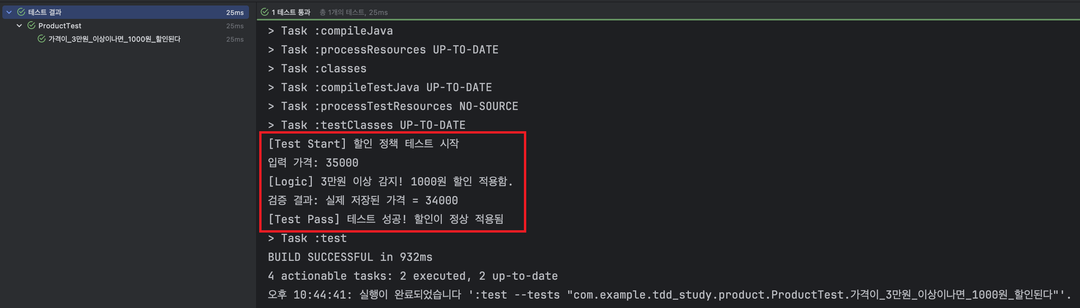
[Test Start] 할인 정책 테스트 시작
입력 가격: 35000
[Logic] 3만원 이상 감지! 1000원 할인 적용함.
검증 결과: 실제 저장된 가격 = 34000
[Test Pass] 테스트 성공! 할인이 정상 적용됨package com.example.tdd_study.product;
import com.example.tdd_study.notification.NotificationCenter;
import org.junit.jupiter.api.Test;
import org.junit.jupiter.api.extension.ExtendWith;
import org.mockito.ArgumentCaptor;
import org.mockito.InjectMocks;
import org.mockito.Mock;
import org.mockito.junit.jupiter.MockitoExtension;
import java.time.LocalDateTime;
import static org.assertj.core.api.Assertions.assertThat;
import static org.assertj.core.api.Assertions.assertThatThrownBy;
import static org.mockito.ArgumentMatchers.any;
import static org.mockito.Mockito.verify;
@ExtendWith(MockitoExtension.class)
class ProductServiceTest {
@Mock
private ProductRepository productRepository;
@Mock // [중요] 이 부분이 없어서 NullPointerException이 발생했습니다.
private NotificationCenter notificationCenter;
@InjectMocks
private ProductService productService;
@Test
void 상품_등록시_고가_상품은_할인되어_저장된다() {
// given
String name = "고급 시계";
int inputPrice = 40000; // 3만원 이상
LocalDateTime fixedTime = LocalDateTime.of(2025, 1, 1, 12, 0);
System.out.println(">>> Service 테스트 시작: " + name + ", 가격: " + inputPrice);
// when
productService.register(name, inputPrice, fixedTime);
// then
// Repository.save()가 호출될 때, 넘겨진 Product 객체를 낚아챕니다(Capture).
ArgumentCaptor<Product> productCaptor = ArgumentCaptor.forClass(Product.class);
verify(productRepository).save(productCaptor.capture());
// [추가] 알림 발송도 검증 (여기서 NPE가 났었음)
verify(notificationCenter).send(any(String.class));
Product savedProduct = productCaptor.getValue();
System.out.println(">>> Repository에 저장된 가격: " + savedProduct.getPrice());
// 40000원이 아닌 39000원이 저장되어야 정상 (1000원 할인)
assertThat(savedProduct.getPrice()).isEqualTo(39000);
System.out.println(">>> Service 테스트 통과 완료");
}
// 기존 테스트 (영업시간 관련)도 함께 유지해야 합니다.
@Test
void 영업시간_외에는_상품_등록이_불가능하다() {
// given
String name = "아메리카노";
int price = 4000;
LocalDateTime fixedTime = LocalDateTime.of(2025, 1, 1, 1, 0); // 새벽 1시
System.out.println(">>> 영업시간 외 테스트 시작 (시간: " + fixedTime + ")");
// when & then
assertThatThrownBy(() -> productService.register(name, price, fixedTime))
.isInstanceOf(IllegalStateException.class)
.hasMessage("영업 시간이 아닙니다.");
System.out.println(">>> 예외 발생 확인 완료");
}
}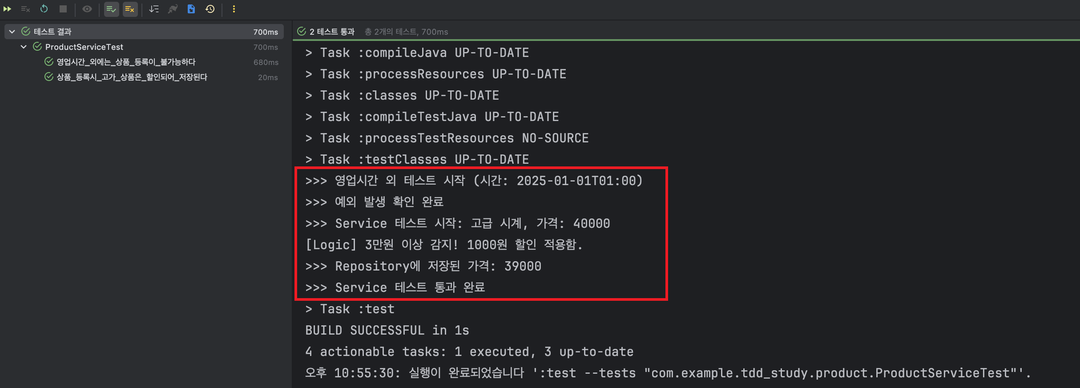
>>> Service 테스트 시작: 고급 시계, 가격: 40000
[Logic] 3만원 이상 감지! 1000원 할인 적용함.
>>> Repository에 저장된 가격: 39000
>>> Service 테스트 통과 완료System.out.println statements, we could see the start of each test, the logic being executed, and the validation results.Product.Next time, we will comparethe roles of unit and integration testsand discuss which tests to write when for an efficient testing strategy.