 Principles of Congestion Control
📅
Principles of congestion control 🔗
Too many sources send data too quickly for the network to handle.
This differs from
flow control
!
Symptoms
- Packet loss: When many packets enter the network at once, router buffers can overflow and packets may be lost. This reduces transmission reliability and communication efficiency.
- Long delays: When network traffic exceeds a router's processing capacity, packets must wait in a queue, causing transmission delays.
Q. How can congestion be detected?
Q. How should we respond once it is detected?
Causes and costs of congestion: Scenario 1 🔗
Conditions
- Two senders and two receivers.
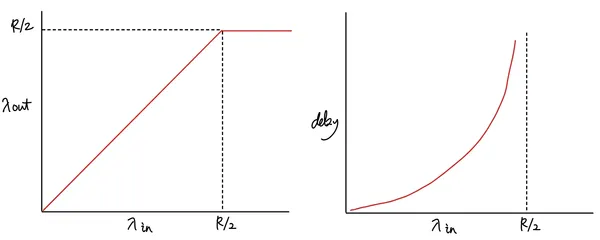
- One router with an infinite buffer → No packet loss.
- Output-link capacity: R.
- No retransmissions.
- An unlimited shared output-link buffer.
Results
- In the arrival-rate vs. throughput graph, the output rate reaches its maximum at , then remains constant as the link saturates.
- In the arrival-rate vs. delay graph, delay rises sharply as the input rate approaches .
Causes and costs of congestion: Scenario 2 🔗
One router with a
finite
buffer.
The sender retransmits packets that time out.- Application-layer input equals application-layer output: .
- Transport-layer traffic includes retransmissions: .
Scenario 2-1 🔗
An idealized network: The sender has perfect knowledge of the router's buffer state.
- The sender transmits only when the router's buffer has enough space.
Scenario 2-2 🔗
An idealized network: The router reports packet loss.
- The sender retransmits a packet when the router reports it lost.
When transmitting at R/2, some packets are retransmissions, but the asymptotic goodput is still R/2.
This reflects the mechanism that maintains a certain goodput even under congestion.
Scenario 2-3 🔗
A realistic network: Duplicates can occur.
- Packets may be dropped at the router when its buffer fills, so a timeout is needed.
- The sender may time out prematurely, send two copies, and have both delivered.
When transmitting at R/2, some packets are retransmissions, including duplicate packets that are delivered.
Costs of congestion 🔗
More work
: Packet loss during congestion forces the sender to retransmit. The network must handle additional work, using resources inefficiently.
Unnecessary retransmissions
: A premature timeout can make the sender transmit the same packet multiple times, consuming link bandwidth with duplicates.
Reduced goodput
: More duplicate packets reduce the effective rate of useful delivery, or goodput, lowering overall network performance.Scenario 3 🔗
Conditions
- Four senders and multihop paths.
- Timeouts and retransmissions.
- : Original data; : Retransmitted data.
Q. What happens as and increase?
A. As increases, every additional transmitted packet arriving at the upper queue is dropped, and its throughput approaches zero.
Another cost of congestion 🔗
Packet loss
: Saturated router buffers can drop packets during congestion, reducing data-transmission reliability and communication efficiency.