The more buzz a tool gets, the bigger the expectations that follow it, often bigger than what it can actually do.
If you install REA after seeing a headline like "AI cloned Adobe and MS Office," and what you actually get is pseudocode for one function, it is easy to be disappointed.
If expectations are not corrected, people end up underrating even what the tool does well.
This part lays out what REA
cannot do
.
It rests on three kinds of evidence.
REA's official documents and disclaimer
The records I made while actually running things in parts 4 and 5 of this series
Third-party articles and analyses
Anything taken from third-party material is attributed sentence by sentence, and anything I could not verify myself is marked separately.
.
The README's FAQ answers that native analysis returns pseudocode and assembly, and JavaScript/Electron analysis returns modules and their relationships.
As we saw in part 2, variable names, comments, and file structure disappear during compilation, so no decompiler can bring them back.
REA's disclaimer↗ states this clearly too.
It says decompilation, reconstruction, heuristics, and AI-assisted analysis
may be incomplete or incorrect
, that results do not guarantee accuracy, completeness, security, compatibility, or legal compliance, and that consequential conclusions should be verified by reviewing the evidence.
It also says that obtaining source-like output does not grant rights to the original program or to that output.
The same limits showed up in the results I ran myself.
Part 4 Electron sample
REA found the structure graph correctly, but listed 58 still-unresolved items (unknowns) in the result.
Its list of limitations included the item
not finding something does not mean it is absent
.
Part 5 -O0 binary
The pseudocode showed names such as param_1 and local_1c instead of the original variable names, and REA attached the note
this is Ghidra decompiler output, not original source
.
Part 5 -O2 binary
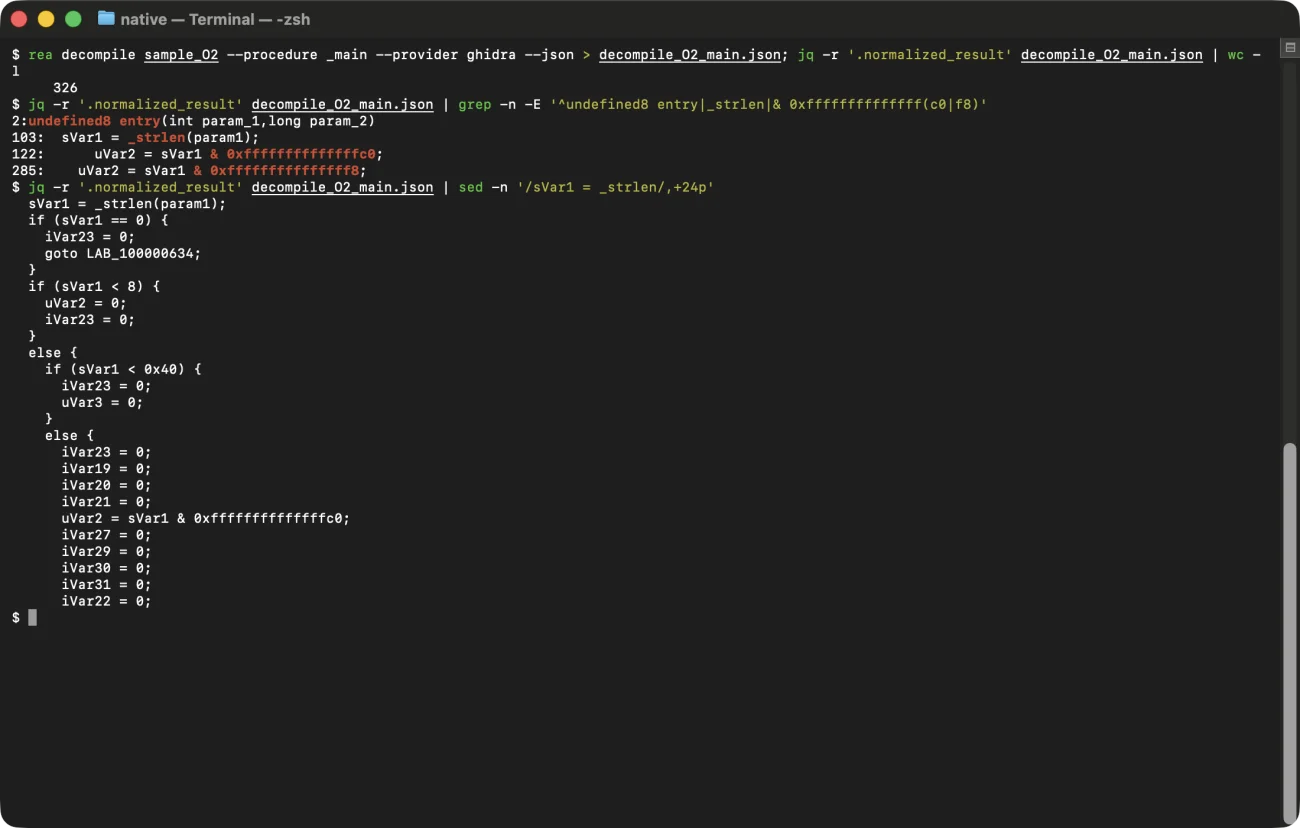
Optimization merged the checksum function into main, so it could not be found by function name at all, and the pseudocode for main grew to 326 lines.
Search results showing the sample_O2 main pseudocode is 326 lines long, with line 2 undefined8 entry(int param_1, long param_2), line 103 sVar1 = _strlen(param1), and the bit-mask operations on lines 122 and 285
The original C code was a 14-line program, counting blank lines.
A single optimization pass multiplied the amount you have to read many times over
, and most programs shipped in the real world are built with optimization on and symbols stripped.
REA hands decompilation to external engines, so it inherits their defects as well.
The installation guide↗ lists known defects that REA records for each Ghidra session.
For example, in Ghidra 12.2.0, some x86-64 switch statements built with Clang -O0 can lose jump-table flow and produce incorrect pseudocode, and certain byte-offset switches on AArch64 lose their jump table.
It is a strength that REA records these defects instead of hiding them, but recording them does not make them go away.
REA only connects analysis tools to the agent; what to ask and how to interpret it is decided by the agent.
So even for the same target, results differ depending on which model you use and how much time and money you give it.
A pbxscience article↗ describes a comparison that shows this.
In an experiment cloning a simple Mac photo viewer, a general coding agent with no reverse engineering tools produced a comparable result, while the REA version had somewhat higher fidelity but took longer.
The article does not give the detailed conditions of this comparison, so I could not verify them in this post.
The takeaway from this comparison is simple.
For a simple app where you only need to match the visible behavior, building it fresh can be faster.
REA earns its keep when you need to
match behavior exactly
, such as the constants in a formula or a file format.
Reading the constants 1.5625 and 500.0 from the bytes in the DX-Ball case in part 6 is that kind of situation.
the phrase Reverse Engineer Anything should not be interpreted as a guarantee of universal format coverage
.
REA's supported targets document↗ also shows that each target needs a different engine and operating system and returns information at a different level.
👍
Large software is not simply a program with more functions.
Decades of file formats, edge cases, and platform-specific behavior are tangled together, so scaling up the approach of matching one function at a time does not restore the whole.
Around the time REA became widely known, reports that "AI built replacements for Adobe and Microsoft products" spread along with it.
That story is about
a separate project called ArtCraft
, not REA.
According to the pbxscience article↗, ArtCraft is a project by developer Brandon Thomas that includes tools modeled on Photoshop, Illustrator, Premiere, Word, Excel, and others.
The article concludes that
ArtCraft and REA have no technical link and ArtCraft was not built with REA
.
An analysis published in Law Times (법률신문)↗ likewise reports that the ArtCraft developer described it as a clean-room reimplementation written only from public documents and observed behavior without looking at original code, and said REA and Ghidra were not used.
The same article says ArtCraft's level of completion should also be viewed with caution.
It reports that the apps are labeled early alpha or in development, that its own roadmap puts Photoshop parity well below 50%, and that testers have reported problems with shortcuts and controls.
👍
The ArtCraft details rest on a third-party article, and I did not check the ArtCraft repository or roadmap directly in this post.
In short, the two projects
only overlapped in timing and theme
; they are separate.
The sentence "Adobe was cloned with REA" is not true.
Pointing out limits does not mean REA is useless.
Here are the situations where REA fits well, based on using it in this series and reading the sources.
Situation
Why
Understanding legacy systems
Tracing the behavior of internal binaries with no source or lost documentation, with evidence
Implementing interoperability
Confirming the exact values of a file format or protocol
Auditing your own app's exposure
Checking whether source maps, secrets, or debug information remain in a release (part 4)
Checking security settings
Confirming binary security settings such as PIE and NX without an engine (part 5)
Assisting malware analysis
Mapping the structure first with static analysis in an isolated environment (part 9)
CTFs and education
Practicing decompilation and verification on small problems with known answers
Software preservation
Function-by-function recovery and differential testing of programs whose makers are gone
On the other hand, it is better to lower expectations in these situations.
When you want to reproduce an entire large commercial product
When you only need the UI and behavior to look similar
When there is no ground truth (original binary or tests) to verify the results against
When you want to analyze software you are not authorized to analyze
REA is not an all-purpose cloning machine but
a reverse engineering assistant that attaches evidence
REA's limits are less hidden weaknesses than the limits of reverse engineering as a task.
The original source does not come back; the results are pseudocode, assembly, and structural information.
The official disclaimer also says results may be wrong and should be verified.
Result quality depends on the model, time, and budget, and simple apps can be faster to build fresh.
The public cases are function-level work on small, old programs, and I found no case of reimplementing large software.
The reports that "AI cloned Adobe" are about a separate project, ArtCraft.
In the next part, we look at how far reverse engineering is legally allowed, based on the original texts of Korean copyright law, US case law, and the EU directive.
 REA Limits and Hype - Why It Is Not Really Anything