The original has changed. This translation is based on an earlier version.
 addyosmani/agent-skills and the Karpathy Guidelines
📅
The original has changed. This translation is based on an earlier version.
addyosmani/agent-skills and multica-ai/andrej-karpathy-skills, the representative repositories for each approach, using their README files and the files from cloning them.
In the TOP 20 ranking compiled in Part 2, as of November 27, 2026, the Karpathy Guidelines had 235,936 stars (4th) and addyosmani/agent-skills had 120,615 stars (11th).
The two repositories split into one that changes the agent's using-agent-skills, is a meta skill that helps pick the right skill for a situation.
The lifecycle is split into six stages: /spec: defines what to build as a specification before writing code./plan: splits the work into small, verifiable tasks./build: implements one slice at a time./test: proves behavior with tests./constraints: sets quality standards once and applies them to every task./review: checks the state of the code before merging./webperf: measures and audits web performance./a11y: audits accessibility./code-simplify: simplifies the code./ship: deploys to production./build auto is an option that, once you approve a plan, runs the remaining tasks autonomously.
According to the README, each task goes through tests and gets its own commit, and it stops at a failure or a risky step.
/review, the README advises using a namespace such as /agent-skills:review.
These commands do not appear in GitHub Copilot, so you need to call the skills by name, such as /spec-driven-development./plugin marketplace add addyosmani/agent-skills
/plugin install agent-skills@addy-agent-skillsnpx skills add addyosmani/agent-skills.
You can view the list before installing with --list, and giving a name such as --skill code-review-and-quality installs only that one skill.
However, the README notes that installing individual skills with npx leaves out the references/ folder at the top level of the repository, and says this is tracked in issue #361↗.Permission denied (publickey) error, and the README recommends the setting below.git config --global url."https://github.com/".insteadOf git@github.com:hooks/ folder for the Claude Code adapter in the cloned repository, you can see several shell scripts such as session-start.sh and sdd-cache-pre.sh.
It is safer to read which event each one attaches to before installing.
In this article, I only cloned the repository and read the files. I did not run the install commands or the hooks.
I could not find the telemetry default in the README, so it remains CLAUDE.md file built on LLM coding pitfalls that Andrej Karpathy observed.
The README lists three problems: the model pushes ahead on wrong assumptions without checking them, it inflates code and abstractions beyond what is needed, and it changes code or comments it does not understand, regardless of the task.The README says every changed line should trace directly back to the user's request.
/plugin marketplace add forrestchang/andrej-karpathy-skills
/plugin install andrej-karpathy-skills@karpathy-skillsskills/karpathy-guidelines/SKILL.md rather than into CLAUDE.md. The .claude-plugin/plugin.json in the cloned repository also points to this path as the skills entry.
In other words, the description "one file" applies to the CLAUDE.md method, and the plugin method takes the form of a skill.curl -o CLAUDE.md https://raw.githubusercontent.com/forrestchang/andrej-karpathy-skills/main/CLAUDE.mdforrestchang address in the install command redirects to the multica-ai/andrej-karpathy-skills repository.
When I queried both addresses with gh api on November 27, 2026, both returned multica-ai/andrej-karpathy-skills.
The repository appears to have moved, but I did not confirm the history of the move.SKILL.md is the entry point and supporting material is read only when needed.
In theory, even with many skills, the context used at session start can be small.
On the other hand, invoking a skill brings its body and steps into context, and one lifecycle command goes through several stages and checkpoints, so the cost grows with each invocation.
The actual difference depends on the size of the instruction file and how often skills are invoked. This article did not measure that size.sample-bugfix, that I built. The task was "Make the failing tests in test/dateUtils.test.js all pass. Do not modify the test file; change only src."
Three things were checked.gh api repos/forrestchang/andrej-karpathy-skills --jq .full_name was multica-ai/andrej-karpathy-skills.node --test shows that only 1 of the 4 tests passes. # tests 4
# pass 1
# fail 3parseDate, the one-month calculation in addMonths, and the year-boundary handling in addMonths.
The formatDate test passes from the start.
Third, I ran each of the three conditions once. The first attempt stopped with Not logged in · Please run /login because Claude CLI authentication was not set up. After confirming authentication, I ran it again on November 28, 2026. Before and after the runs, I restored the sample to its original state.| Condition | Setup | Turns | Cost (USD) | Changed diff lines (added+deleted) | Tests |
|---|---|---|---|---|---|
| None | Only the task is given | 8 | 0.009738 | 2 (+1 / -1) | 4 of 4 pass |
| Karpathy Guidelines | Copied the CLAUDE.md text into the sample, then ran | 9 | 0.010856 | 2 (+1 / -1) | 4 of 4 pass |
| addyosmani/agent-skills | Loaded with --plugin-dir, prefixed the task with /build (did not use /spec) | 7 | 0.008959 | 2 (+1 / -1) | 4 of 4 pass |
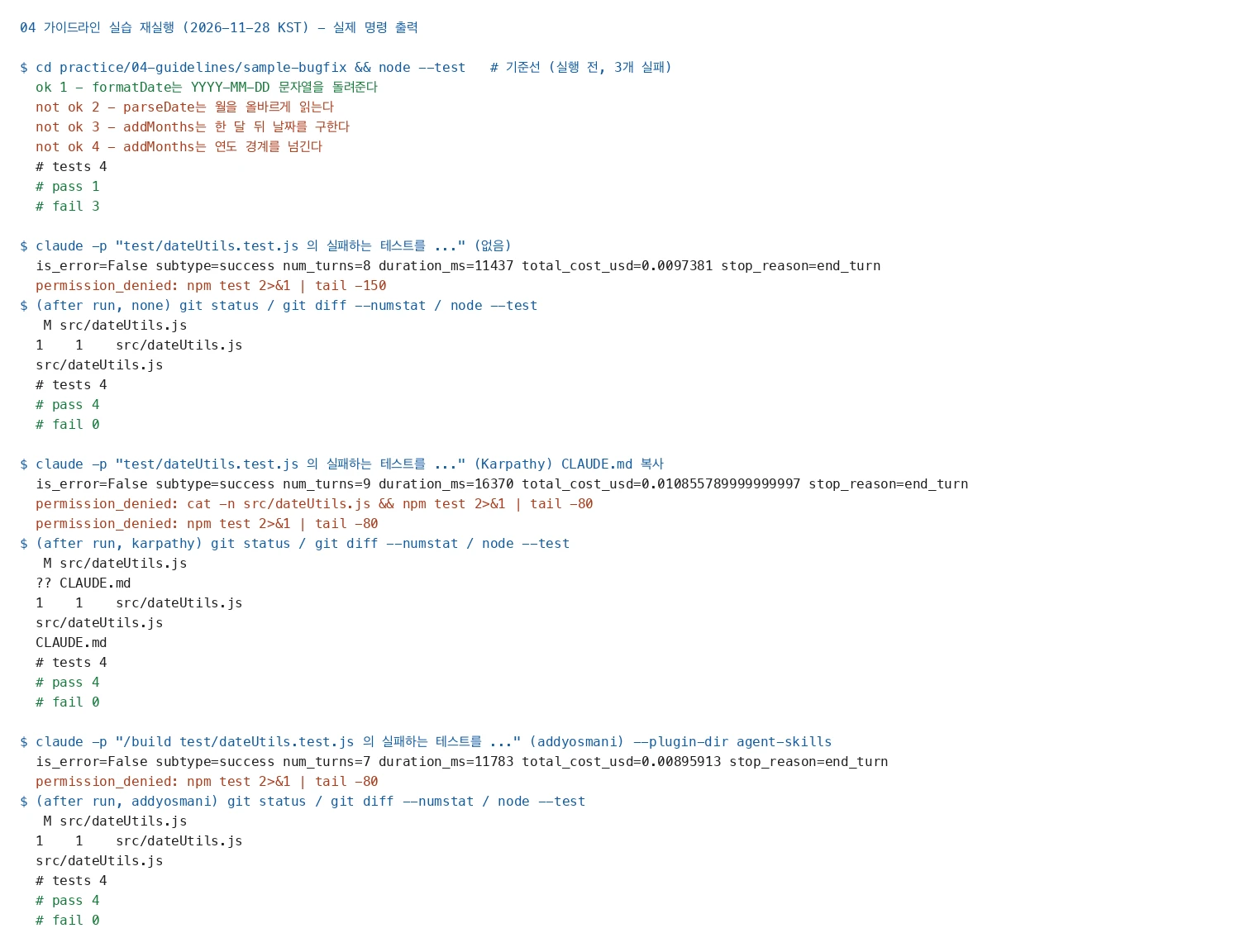
src/dateUtils.js to return new Date(year, month - 1, day);. They did not touch the test file, and no extra files were created. The CLAUDE.md used in the Karpathy condition was a file I copied as input, so I deleted it after the run.
The key observation from this experiment is that the results were the same. The differences in turns and cost (7 to 9 turns, 0.0090 to 0.0109 USD) may be variation from a single run per condition, so I do not use them to rank the conditions.
All three runs flagged the month-end overflow, where addMonths('2026-01-31', 1) becomes '2026-03-03', but said it was outside the task's scope and did not fix it.
Three things were not verified.CLAUDE.md was actually read was not confirmed. The result JSON has no file-read record./build was recognized and invoked as a plugin command was not confirmed. The result JSON has no skill or command record, and the final response does not mention the /build flow.npm test, which is outside the allowlist, was rejected, and the agent ran node --test instead.CLAUDE.md, skills/karpathy-guidelines/SKILL.md, and the hooks/ folder.
Reading before installing is the cheapest check.