Design Engineer Skills from Emil Kowalski and Jakub Krehel | PromleeBlog
If you ask Claude Code to build a button, the functionality usually comes out right.
But the motion can feel awkward when pressed, or the layout breaks with a long user name.
These details are what design engineers catch with the sense they have built up over years.
Putting that sense into files is what a design engineer skill does.
A skill is a bundle of SKILL.md instruction files that an agent reads when it needs them.
To put it plainly, these two repositories are closer to a checklist for polishing an existing UI than to tools that build a screen from scratch.
That said, I did not run install commands such as npx skills add. I pointed both repositories at Haiku with --plugin-dir and sent the same request. The results are measured, but I could not confirm whether the skills were actually invoked.
Emil Kowalski's README says that skills are a by-product of domain expertise.
He takes the position that AI does not replace expertise but
amplifies it
, and he says he built the skills from his work at Vercel and Linear.
Jakub Krehel introduces himself on jakub.kr as the
founding design engineer
of Interfere, and he also runs the magazine Interfaces.
The skills in his repository carry over topics he has covered in both places.
Their concerns are the same.
Agents can build features, but they lack taste.
Emil explains that small mistakes, such as choosing ease-out instead of ease-in for an entrance animation, add up and decide the quality of the result.
emilkowalski/skills: Focused on Motion and Interaction 🔗
According to the README, the install command is npx skills@latest add emilkowalski/skills. I did not run it in this exercise.
The repository is MIT licensed and was created on March 16, 2026. As of GitHub on November 28, 2026, it has 60,589 stars.
The README lists 19 skills. The repository's skills/ folder contains 20 SKILL.md files. The one missing from the list, write-swift, is guidance for Swift code, so this post does not cover it.
The core is emil-design-eng. The README describes it as covering mainly animation, with some design advice.
review-animations checks motion strictly against the author's rules, and improve-animations audits the whole codebase and produces a prioritized plan.
The rules in the web document agents-with-taste are concrete.
Size changes start from scale(0), not scale(0.95), and entrances and exits use ease-out.
Durations for modals and drawers are 200 to 300ms. These figures are the author's rules, not values verified independently.
The skill worth a closer look is learn-taste. According to its SKILL.md, it records design corrections from a session, along with the reasons, in DESIGN.md or lint rules.
It shows a diff before writing and writes only the items you approve.
jakubkrehel/skills: Reviews Every Area of the Interface 🔗
The install command is npx skills add jakubkrehel/skills. The repository is MIT licensed and was created on July 10, 2026. As of GitHub on November 28, 2026, it has 12,934 stars and 16 skills.
The largest group is the better- series.
better-interface reviews accessibility, layout, copy, typography, color, UI, and motion together, and produces one ranked report.
state-machine draws every state of a component with mock data, and interface-review picks out only the problems that are new or worse in changes before a branch or commit.
Two skills need attention.
afk creates improvement proposals on a local branch while you are away, and leaves a report. It changes code without supervision, so check the branch and permissions first.
upskill reads past sessions, suggests hooks or automations, and creates only the ones you choose.
The repository has no hook or execution script files. It contains only per-agent metadata, a plugin manifest, and opencode.json.
It is also registered as a plugin, so avoid installing the same skills through both paths.
jakub.kr/skills shows six FAQ questions, but the answers are collapsed, and I could not read them during this research. The supported agents and update method are unverified.
The four skills in Part 6, ui-ux-pro-max, taste, hallmark, and impeccable, turn rules into data and checks.
The two repositories in this part turn expert judgment into prose.
Item
Four repos in Part 6
emilkowalski/skills
jakubkrehel/skills
Approach
Database search, random themes, deterministic linting and gates
Expert rules and figures, centered on motion
Expert rules, reviewed by area
Strengths
Building a page from scratch, detecting AI slop
Choosing animations, performance, validating UI with extreme data
Reviews accessibility, typography, color, and copy at once, renders every state
Scripts and hooks
Yes (Python search, exit hooks, detectors, and so on)
None in the repository files
None in the repository files
File writes
Install hooks can touch user settings (watch out for Hallmark and Impeccable)
learn-taste records to DESIGN.md and similar files
upskill writes to .upskill/, afk writes to a local branch
External transmission
Impeccable sends a request to its creator's site when generating a new design (guide 0-5)
No telemetry text found in SKILL.md
No telemetry description found on the page
Some skills overlap, such as Emil's break-ui and Jakub's break.
So these two repositories seem to add the most value
when fixing components that already exist
. This judgment comes from reading the SKILL.md files, not from running them.
I could not confirm skill invocation. The result JSON has no tool call records, and the response text does not mention any skill names, so I could not prove that a skill was invoked in any of the three conditions. The differences below are recorded as observations only.
The original plan was to run several skills in sequence against the React components on this blog. What I actually did was different. I used a static HTML page built for teaching (three cards in a list and one "Save" button) and sent the same request while changing only the skill condition. I have not yet run the exercise on the blog's React components, nor run the other skills.
The request text is the same in all three conditions. I sent 이 카드 목록에 호버 모션과 버튼 로딩 상태를 추가해 줘 to Haiku (claude-haiku-5-5) with claude -p, running each condition once.
Condition A: no skill
Condition B: emil skill, with --plugin-dir pointing to the root of the emilkowalski/skills repository
Condition C: jakub skill, with --plugin-dir pointing to the root of the jakubkrehel/skills repository
All conditions used --output-format json, --max-budget-usd 1, and --permission-mode acceptEdits. The allowed tools were Read, Edit, Write, Glob, and Grep, and Skill was added only for B and C.
The cost was small. The total_cost_usd in the JSON was $0.01257 for A, $0.01114 for B, and $0.01001 for C, about $0.034 across the three runs. Turn counts were 9 for A, 6 for B, and 5 for C.
Permissions were denied once each in A and B. In both cases Claude tried to check syntax with Bash and was blocked (A used python3, B used awk). So the syntax check on the generated HTML did not run in any condition. C had no denials.
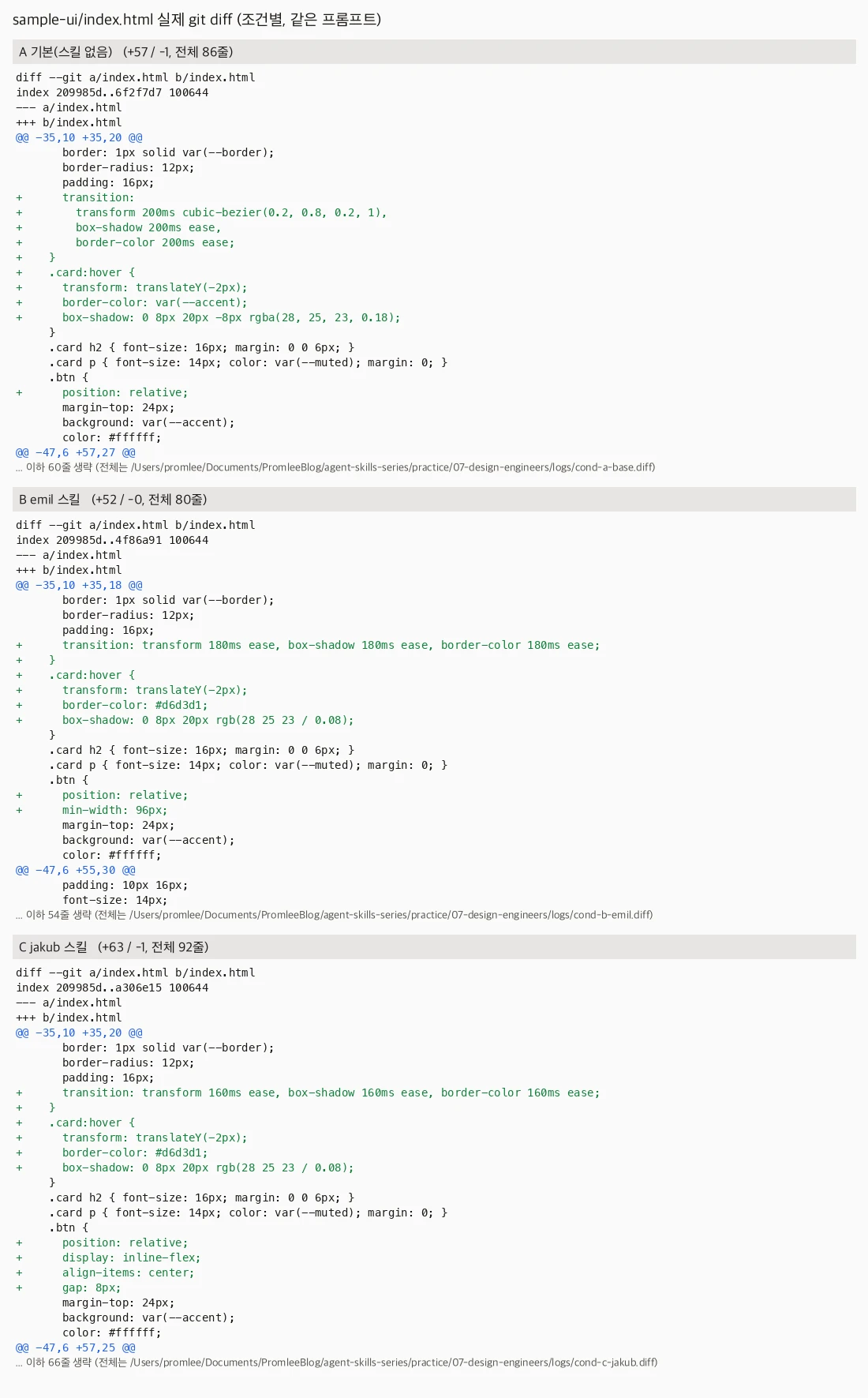
In all three results only one file, index.html, changed. Line changes were +57/-1 for A, +52/-0 for B, and +63/-1 for C. The image below shows the start of each condition's git diff. The full diffs are saved as log files.
Summary of the git diff for index.html in each condition. Shows added and removed line counts and the first part of the changes for the default, emil, and jakub conditions
The differences by condition are shown in the table below.
Item
A default
B emil
C jakub
Transition time
200ms
180ms
160ms
Card hover
Moves up 2px, border in accent color, shadow
Moves up 2px, border #d6d3d1, shadow
Moves up 2px, border #d6d3d1, shadow
Button press
None
scale(0.98)
None
Loading indicator
Spinner added, "Saving…" text
Text made transparent, spinner via ::after
Spinner and "Saving…", then "Saved" or "Save failed"
Button minimum width
None
96px
None
Accessibility attributes
aria-busy, spinner aria-hidden
aria-busy, aria-disabled
aria-busy, spinner aria-hidden
Reduced-motion branch
Yes
Yes
Yes
Save simulation
setTimeout
setTimeout
fakeSave() Promise and try/catch
I record these differences as observations only. Even with the same request, the transition times, press effects, and loading presentation differed by condition. However, I cannot tell whether the skills caused those differences. I could not confirm skill invocation, and I ran each condition only once, so I also cannot tell how much variation exists within a condition.
None of the three results was opened in a browser to check the hover and loading behavior. The judgment that they work comes from reading the diffs, not from running them.
This exercise supports three points. The same request produced different output under different conditions. A single run costs around $0.01. And it is still unknown whether the skills were actually used. To evaluate skill effects, the runs need to be repeated with --output-format stream-json --verbose so that tool calls are recorded.
These two repositories hand an agent a standard for a good screen. Emil focuses on motion and state verification, and Jakub on reviewing the whole interface.
They work through instructions alone, but remember that those instructions can change files and branches.
Turning corrections into rules so the next agent does not repeat the same mistakes is covered again in Part 13, "Building a Custom SKILL.md".
 Design Engineer Skills from Emil Kowalski and Jakub Krehel