Writing and Research Agent Skills: humanizer, last30days, and i-have-adhd | PromleeBlog
Blog drafts come out quickly, but polishing them takes far longer.
When one post contains an introduction that opens with "In today's fast-changing environment," lists of benefits grouped in threes, and "In conclusion" at the end of every paragraph, readers close it at the first paragraph.
This is also why agent skills that help with writing are gaining popularity.
This installment covers three skills for writing and research: humanizer, last30days, and i-have-adhd.
First, let me explain the test conditions.
On November 27, 2026, the Claude CLI login had expired, so the humanizer run ended with the response Not logged in · Please run /login.
After logging in on November 28, I ran the tests again and got results for three humanizer runs and two i-have-adhd runs. I did not run last30days because it requires an external search key.
So this post combines an explanation drawn from the repository files and READMEs with five actual run results.
I will mark separately what I confirmed by running and what the README states.
🖐️
The inputs for this test are three English sample paragraphs I wrote myself. I did not copy any particular article. They are teaching examples in which I deliberately included expressions that sound like AI.
humanizer: the principle of removing AI tone and the creator's claims 🔗
Among the skills that revise AI-written text so it reads like human writing, humanizer is the most widely known.
According to the README, this skill
keeps the claims as they are and only fixes the expression.
It is based on the Signs of AI writing↗ list compiled by Wikipedia editors to identify AI-written text, and it checks 26 patterns.
The patterns are ordered from strong signals: phrasing that sets up a point through contrast, one-line closing sentences, profound-sounding aphorisms, preamble before the main point, and sentences that raise an objection no one made.
The README explains that the first five are corrected even if they appear only once.
humanizer is not a tool for evading AI detectors. It is
a tool for editing for human readers
.
To support its caveat that most signals depend on the model and the type of text, the README cites an arXiv paper by El Attar and others.
A paper analyzing linguistic indicators for detecting AI-generated English text↗ examined 284 linguistic indicators. Its abstract reports that many indicators depend on context, and that only lexical richness appeared strongly across several models and domains.
Because this study deals with English text, I do not use it as evidence for effects on Korean writing.
When given a file, the tool reportedly edits only the prose and leaves code, data, frontmatter, and link targets untouched.
For use in blog MDX, this condition matters.
However, I did not verify in this test whether component tags such as <Img> or <Ads1/> are distinguished from prose and left intact.
So it is safer to compare results on a copy first rather than applying the tool directly to the manuscript file.
The creator's performance claims also need to be examined.
The README states that in a blind test, judges preferred the revised text 16 times out of 16, and it cites issue #229 as the basis.
This figure is
the creator's claim, and it depends on its source.
This test did not verify the claim. I also did not check the number of test sentences, the composition of the judges, or the judging criteria.
The top of the README carries a sponsor notice, so I note it here as well.
According to the README, the install commands are /plugin marketplace add blader/humanizer and /plugin install humanizer@humanizer.
It requires Claude Code 2.1.142 or later. In this test I loaded the repository as a session-only plugin with --plugin-dir, and I did not run the install commands.
The repository had no hook configuration file, and scripts/validate-package.py was a script that checks the package files.
A skill is a structure in which an agent follows instructions written by someone else, so the most reliable step is to read SKILL.md yourself before installing.
last30days: recent 30-day sources and requirements 🔗
When choosing a blog topic, the first thing you need is recent material.
last30days↗ is a skill that, when run as /last30days <주제>, collects posts from the past 30 days across several sources, scores them by engagement, and merges them into a single briefing.
According to the README, Reddit, arXiv, Techmeme, and patent search work without an API key.
X search requires either the X_BEARER_TOKEN setting or a browser token.
TikTok and Instagram use the ScrapeCreators route if a key is present. Without a key, they are fetched with yt-dlp, which returns fewer results.
ScrapeCreators is pay-as-you-go after 10,000 free requests, and it requires Python 3.12 or later.
👍
According to the README, if keys such as OPENAI_API_KEY or GEMINI_API_KEY exist in the shell environment, the research topic and search snippets are sent to the selected external model during the default reranking step.
Keys set up for other tools can also be included.
If you research a sensitive topic, check CONFIGURATION.md, which explains the reranking provider priority, and switch to local processing.
If you set LAST30DAYS_STORE=1, results accumulate in a local SQLite file, research.db. The README says this database is not uploaded to any remote service.
As a research tool for a blog, its strengths are that it shows sources and lets you check how recent the information is.
However, high social engagement does not mean a fact has been verified.
Claims in the briefing should be checked against the original sources.
As of November 27, 2026, it had more than 75,000 stars on GitHub.
According to the README, installation uses /plugin marketplace add mvanhorn/last30days-skill and /plugin install last30days.
I did not run it in this test.
Because external searches such as X and TikTok require an API key or a browser token,
it was not run in this test, and this post does not evaluate the quality of its search results.
i-have-adhd: an output format that puts the answer first 🔗
i-have-adhd↗ is a skill that changes the response format of a coding agent.
The README explains that it puts the next action first so the answer is not buried in explanation, numbers multi-step instructions, and drops greetings and closings.
In the README example, an answer that began with "Great question!" and went on at length becomes a numbered list that first gives the file path and command to change.
There are ten rules: start with the next action, number multi-step instructions, end with one concrete next step, suppress side tangents, restate the current state every turn, estimate time in minutes, make progress visible, state errors calmly, keep lists to five items or fewer, and drop introductions, summaries, and closings.
The README says it loosely draws on
The Adult ADHD Tool Kit
.
Because this skill assumes readers with ADHD, its wording needs particular care.
The README says it can be used without a diagnosis, and the skill body assumes that working memory is short and starting tasks is hard.
This explanation is a design assumption set out by the creator, and the README contains no material proving its effect.
The author's interpretation is that more than 62,000 stars (as of November 27, 2026, on GitHub) can be read as shared agreement that "AI answers are verbose."
In this post, too, I will not treat ADHD as a lack of ability or as a joke.
Whether these rules suit long-form writing requires judgment.
The rules are designed for answering work instructions, so I cannot tell whether a format without introductions and closings suits explanatory writing.
The test ran each question once, and I did not verify whether it fits long explanatory writing. I record this point only as the author's judgment.
To install, paste the copy-ready text from the README into the CLI, or use claude plugin marketplace add ayghri/i-have-adhd and claude plugin install i-have-adhd@i-have-adhd from lines 122 to 123 of INSTALL.md.
In this test I loaded the repository with --plugin-dir, and I did not run the install commands.
Installing a skill means its hooks and scripts can run with your account's permissions.
This repository has a SessionStart hook that runs when a session starts.
👨💻
Once installed, the hook runs every time a session starts. According to the comments in the shell version of the hook (hooks/always-on.sh), the rules are added only when a file named .i-have-adhd-always exists under $CLAUDE_CONFIG_DIR (default ~/.claude). If you do not want always-on mode, do not create that file. I did not read the Node version of the hook this time.
Test log: results after rerunning following an authentication failure 🔗
The first attempt on November 27, 2026 ended with an authentication problem. I passed the English humanizer sample p1 to /humanizer, but the response was Not logged in · Please run /login, and the cost was 0. Because this was an authentication problem, it has nothing to do with the skill's quality. I have kept this failure record as it is.
On November 28, 2026, after logging in, I ran the same repository again. The model was claude-haiku-5-5 (--model haiku), and I set a cost cap of $1 on each call. I ran three humanizer cases and two i-have-adhd cases once each, and all five calls ended with is_error set to false.
The inputs are three English paragraphs written for this post. Word counts are whitespace-based, and the final version is the last quoted block in the output. All three were run once.
Input sample
Original features
Result summary
Meaning preserved
p1 AI tone (3 sentences, 51 words)
"not X but Y" contrast structure, exaggerated words such as "testament" and "tapestry," rule of three, em dashes
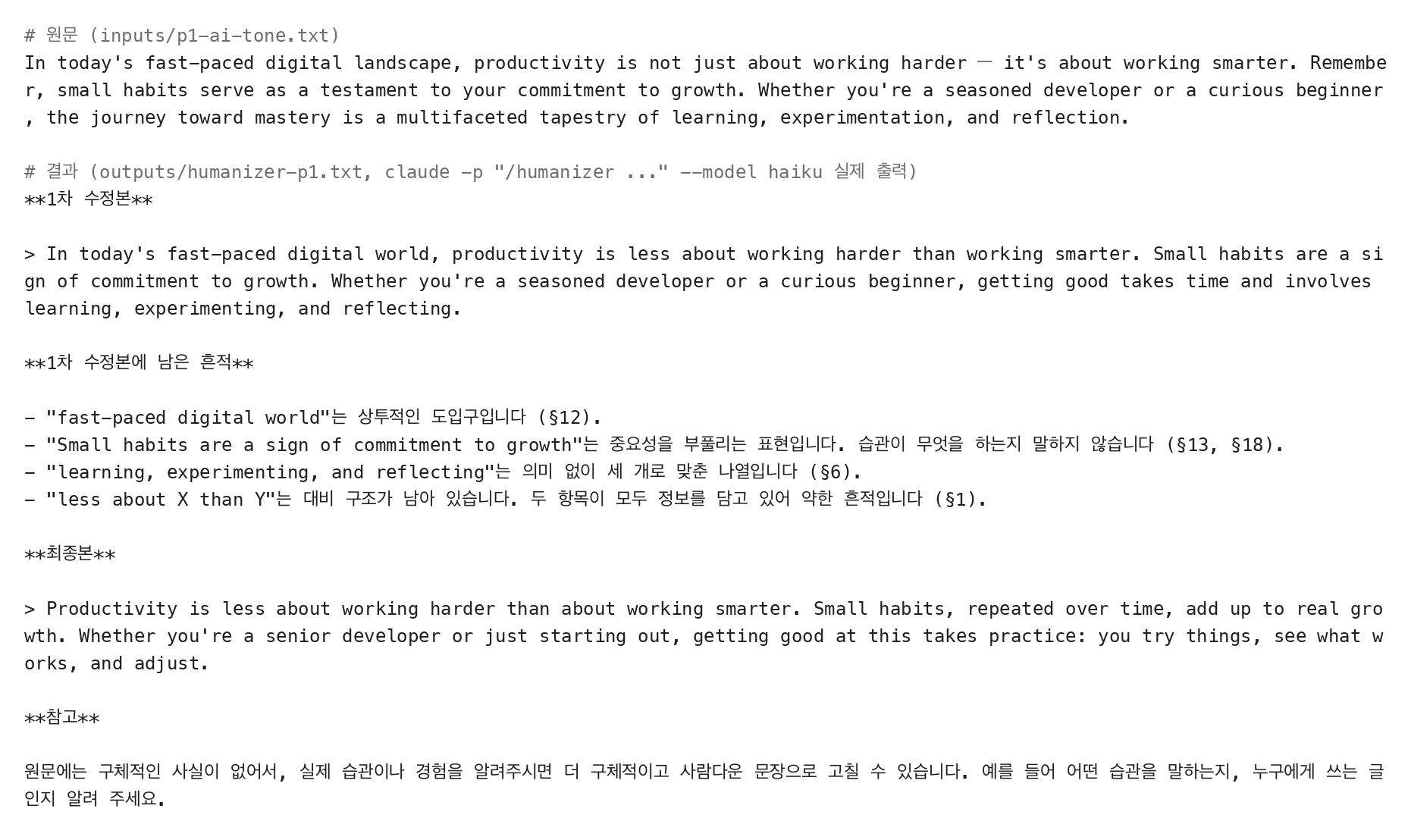
It produced a first revision and a list of four remaining traces, then a final version of 3 sentences (43 words). The opener "fast-paced digital world" was dropped, and the three-item list was rewritten as "you try things, see what works, and adjust."
Not yet judged
p2 promotional copy (3 sentences, 55 words)
promotional words such as "revolutionary," "game-changer," and "pivotal," and unsupported claims
The first revision and the final version are the same 3 sentences (23 words). The modifiers "robust, intuitive, innovative" were removed. The model noted that it did not add features or integrations it did not know about.
Not yet judged
p3 chatbot residue (5 sentences, 47 words)
"Great question!", bold labels, the closing cliché "In conclusion"
The final version is one sentence, "Clarity matters more than speed." (5 words). The model judged that the original had only one real claim and said it removed the rest.
Not yet judged. The original 5 sentences were reduced to 1, so a person needs to read it to confirm whether the detailed claims remain
Meaning preservation has not yet been judged by a person, so that column stays at "Not yet judged." I will not write "preserved" without a judgment.
The figure is a redrawing of the saved original and result text, not a capture of the app screen.
Image redrawing the original of English sample p1 and the humanizer result text. It shows the first revision, the list of remaining traces, and the final version
humanizer has two limitations. First, it is an English-based skill, so in this test I did not apply it to Korean text. Second, I did not verify the creator's blind-test claim of 16 out of 16.
The question was: "I need to publish a blog post today. The draft is done, and thumbnail creation and link checking are left. What should I do first?" The baseline response was produced without the skill, and the skill response was produced by explicitly invoking /i-have-adhd. I confirmed that the skill was loaded from the registered entry in the run log (i-have-adhd:i-have-adhd). Both responses asked for the draft file path, because no draft to publish could be found in the test folder. Since the question did not include a file, this comparison shows only the difference in response format.
Response
Turns
Cost (USD)
Result length
Observation
Baseline
3
0.0086
691 characters
Asked two questions to confirm as a numbered list. Opened with a long explanation recommending the order "link check, thumbnail, final publish check."
Skill
2
0.0079
431 characters
Started with "Next action: please tell me the draft file path." Added estimated time to each step of a numbered three-step list (link check about 10 minutes, thumbnail about 20 minutes).
Because this test ran one question once each, I make no claim that the skill response is better. I confirmed only the difference that the next action came first.
Not run:
last30days: external searches such as X and TikTok need an API key or browser token, so I did not run it. I did not evaluate the quality of its search results.
korean-humanizer and a comparison of humanizer on Korean paragraphs: outside the scope of this test, so not run.
Install commands: none of the three skills' install commands were run.
I also did not judge humanizer's revision quality. The meaning-preservation column is left for a person to read and judge.
Points to check when applying these to Korean writing 🔗
The humanizer README examples and all 26 patterns are based on English writing.
So I will not claim that applying it as-is to Korean writing is effective.
In this test as well, humanizer was run only on three English samples and was not applied to Korean text.
This blog edits its manuscripts with the korean-humanizer skill.
The two skills share a purpose but differ in design approach.
The SKILL.md of korean-humanizer divides traces into three levels: S1 (decisive), S2 (strong), and S3 (weak).
It warns when the share of text changed by revision exceeds 30%, and it is set to stop work when the share exceeds 50%.
By contrast, I could not find a change-rate threshold in the humanizer README.
Instead, humanizer marks items that are
weak signals on their own
, such as em dashes and curly quotes, with a separate label.
This comparison comes down to three points:
Severity classification: both skills handle weak signals separately.
Change-rate limit: korean-humanizer sets a numeric threshold, while I could not find one in humanizer.
Korean-specific traces: translation-style phrasing is not among humanizer's 26 patterns, and the passive-voice item (No. 11) is based on English.
This test did not verify which skill produces more natural Korean.
A follow-up experiment that feeds the same Korean paragraph into both skills and compares the results is left as a future test.
The three skills cover different stages of writing and research.
humanizer is an editing tool that fixes sentence expression, last30days is a research tool that gathers material, and i-have-adhd is a rule that changes the response format.
In this post, I confirmed the run results of three humanizer cases and two i-have-adhd cases. However, I did not judge revision quality or meaning preservation. Whether to apply these tools to an actual manuscript is best decided after comparing the results on a copy.
Readers who fit each skill can be divided as follows:
Anyone who wants to reduce the AI feel of an English manuscript can consider humanizer. However, the creator's claims depend on their source.
Anyone who wants to skim recent material quickly can consider last30days. First check the key setup and the scope of external transmission.
Anyone who is tired of long answers and needs the next action right away can consider i-have-adhd. Its hook is controlled by a flag file.
Installing a skill means running instructions and scripts someone else wrote with your account's permissions.
Before installing, check the hooks, scripts, and telemetry defaults. This point is covered in detail in Part 12.
 Writing and Research Agent Skills: humanizer, last30days, and i-have-adhd