 Contention-Free Protocols
📅
Frequency Division Multiple Access (FDMA) 🔗
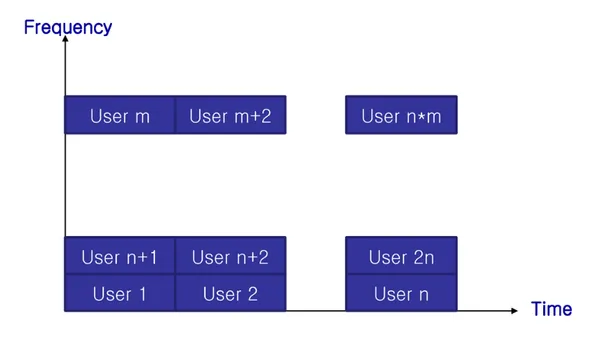
FDMA gives each user a separate frequency band so that users can transmit simultaneously.
It requires substantial guard bands to reduce interference between frequencies, which makes it inefficient.
All first-generation mobile systems used FDMA.
Time Division Multiple Access (TDMA) 🔗
TDMA gives each user a separate time slot so that multiple users can share the same frequency band.
Because users share a frequency band, interference between their frequency bands is not an issue.
Most second-generation mobile systems used TDMA.
Combining FDMA and TDMA 🔗
Each channel is assigned a particular frequency band for a set period of time.
Advantages
- Resistant to frequency-selective interference.
- Time compression can improve transmission efficiency.
- Helps prevent eavesdropping.
Disadvantages
- Coordinating frequency changes is difficult.
Code Division Multiple Access (CDMA) 🔗
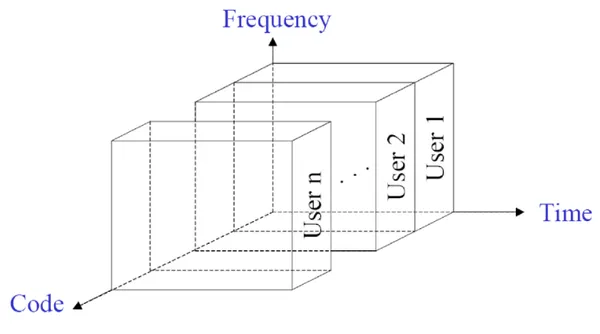
CDMA assigns each user a unique code so that users can transmit simultaneously.
The transmitter modulates data using a specific code. The receiver demodulates the signal with the same code to recover the data.
Users share bandwidth by using mutually orthogonal code sequences.
Some second-generation and most third-generation mobile systems used CDMA.
Channel Types 🔗
Control channels
- Downlink carries control information from the base station to the mobile device.
- Uplink carries control information from the mobile device to the base station.
Traffic channels
- Downlink carries data from the base station to the mobile device.
- Uplink carries data from the mobile device to the base station.
Duplexing for Radio Links 🔗
Frequency Division Duplexing (FDD)
- The downlink and uplink use separate frequency bands.
- Signals can be transmitted continuously on both links in parallel.
Time Division Duplexing (TDD)
- The downlink and uplink share the same frequency band.
- The two directions alternate, like a game of ping-pong.
Duplexing in FDMA 🔗
The uplink (UL) and downlink (DL) use different frequency bands.
- UL goes from the user to the base station.
- DL goes from the base station to the user.
Channel Structure 🔗
The frequency band is split into several channels.
- The guard band () reduces interference between channels.
- The sub-band () is the frequency band of a channel.
- The total bandwidth () is the combined bandwidth of the channels.
- The protecting band separates the uplink and downlink frequency bands.
Duplexing in TDMA 🔗
In this arrangement, the uplink (UL) and downlink (DL) use the same frequency band.
- UL goes from the user to the base station.
- DL goes from the base station to the user.
- A slot is a unit of time during which only one user can transmit.
Channel Structure 🔗
Time is divided into slots.
- In TDMA, users share the frequency band, so there is no interference between separate frequency bands assigned to those users.
- Each frame contains several slots, and each slot is assigned to a user.
- The uplink and downlink transmit in turn.
- A slot contains:
- Guard time between transmissions.
- A header with information about the slot.
- User data.
Duplexing in CDMA 🔗
Frequency Hopping Spread Spectrum (FHSS) 🔗
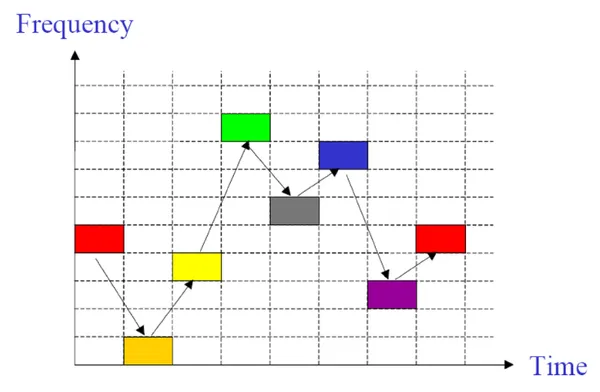
- The signal is transmitted by hopping through a sequence of frequency channels.
- The graph shows how the frequency changes over time.
- Each color represents a particular frequency band.
Direct Sequence Spread Spectrum (DSSS) 🔗
Data is mapped to a bipolar representation before transmission.
has the opposite polarity to .
The sequences of two different stations () are orthonormal.
A sequence and its negation satisfy the following relationship.
During each bit interval, a station can:
- Transmit its chip sequence to send a 1.
- Transmit the negation of its chip sequence to send a 0.
- Stay silent by transmitting nothing.
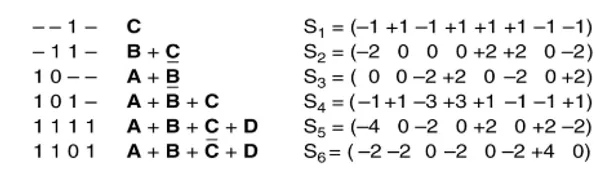
When two or more stations transmit at the same time, their bipolar signals add linearly.
The receiving station () recovers the data using the following calculation, with m = 8.
For example, suppose .
- The result shows that a 1 was transmitted, independently of the signals from A, B, and D.