UML artifacts created during design, such as interaction diagrams and design class diagrams (DCDs), serve as inputs to code generation.
Implementation model
- All implementation artifacts:
- Source code, database definitions, JSP/XML/HTML pages, and so on.
When implementing a design in an object-oriented language, write source code for:
- Class and interface definitions.
- Method definitions.
Converting a UML design to code
- From class diagrams to
class definitions
.
- From interaction diagrams to
method bodies
.
Creating class definitions from a DCD 🔗
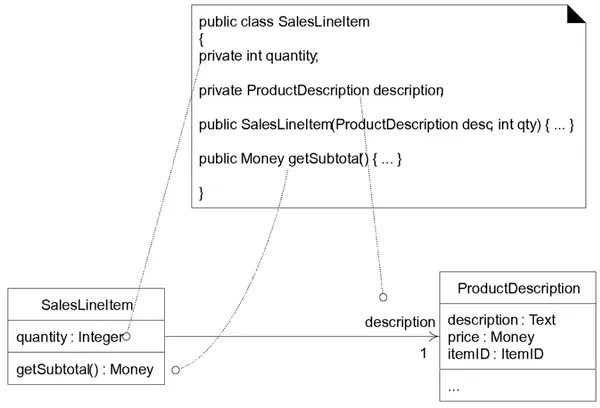
A DCD contains enough information to create basic class definitions in an object-oriented language.
Defining attributes as Java fields
:
Declare the attributes in the DCD as Java fields.
- For example,
quantity: Integer maps to private int quantity;.
- For example,
description: ProductDescription maps to private ProductDescription description;.
Method signatures
:
Declare the operations in the DCD as Java methods.
- For example,
getSubtotal(): Money maps to public Money getSubtotal() { ... }.
Creating method bodies from interaction diagrams 🔗
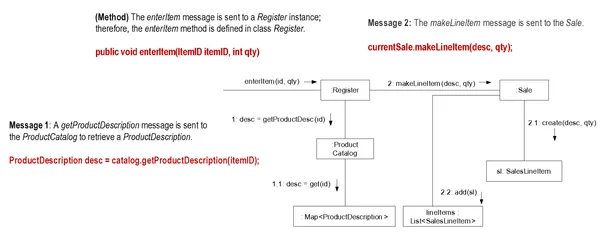
The message sequence in an interaction diagram becomes a sequence of statements in a method definition.
Extracting messages from an interaction diagram
:
- An
enterItem message is sent to a Register instance, so the enterItem method is defined in the Register class.
- Follow the message sequence to implement the method's behavior in code.
- Message 1: Send
getProductDescription to the ProductCatalog object to retrieve a product description.
- Message 2: Send
makeLineItem to the Sale object to create a sales line item.
- Convert the messages into code statements to implement the
enterItem method.
예시 코드public class Register {
private ProductCatalog catalog;
private Sale currentSale;
public Register(ProductCatalog catalog) {
this.catalog = catalog;
this.currentSale = new Sale();
}
public void enterItem(int itemID, int qty) {
ProductDescription desc = catalog.getProductDescription(itemID);
currentSale.makeLineItem(desc, qty);
}
}
Collection classes in code 🔗
An important tool for managing and manipulating multiple objects in object-oriented programming.
They are especially useful for representing
one-to-many
relationships.
Object-oriented languages implement this by introducing
collection objects
:
- List (ArrayList implementing the List interface): An ordered list that can grow.
- Map (HashMap implementing the Map interface): Key-based lookup.
- Plain arrays.
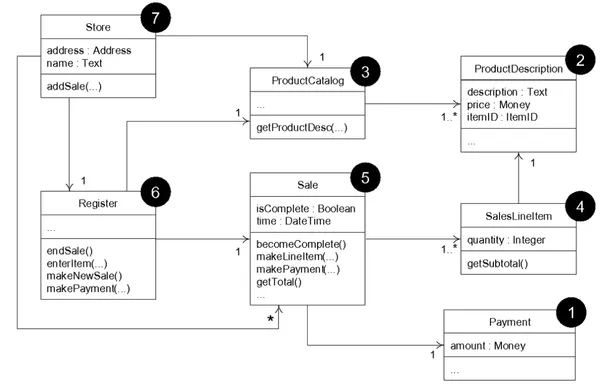
Implement classes in order from lower coupling to higher coupling.
- Payment or ProductDescription can be implemented first.
- Next come classes that depend only on those already implemented, such as ProductCatalog or SalesLineItem.
 Mapping a Design to Code