We fixed all the requirements over two months before starting design. When implementation began, many items turned out to rest on assumptions that no longer held.
Finishing the requirements took so long that design started late, and the cost of applying the changed requirements grew far beyond the original plan.
In iterative development, requirements also become more detailed a little at a time, in each iteration, to reduce this problem.
This post builds on the iteration structure covered in the previous post, and explains how requirements are divided, selected, and refined.
In iterative design, requirements are not completed as one finished document.
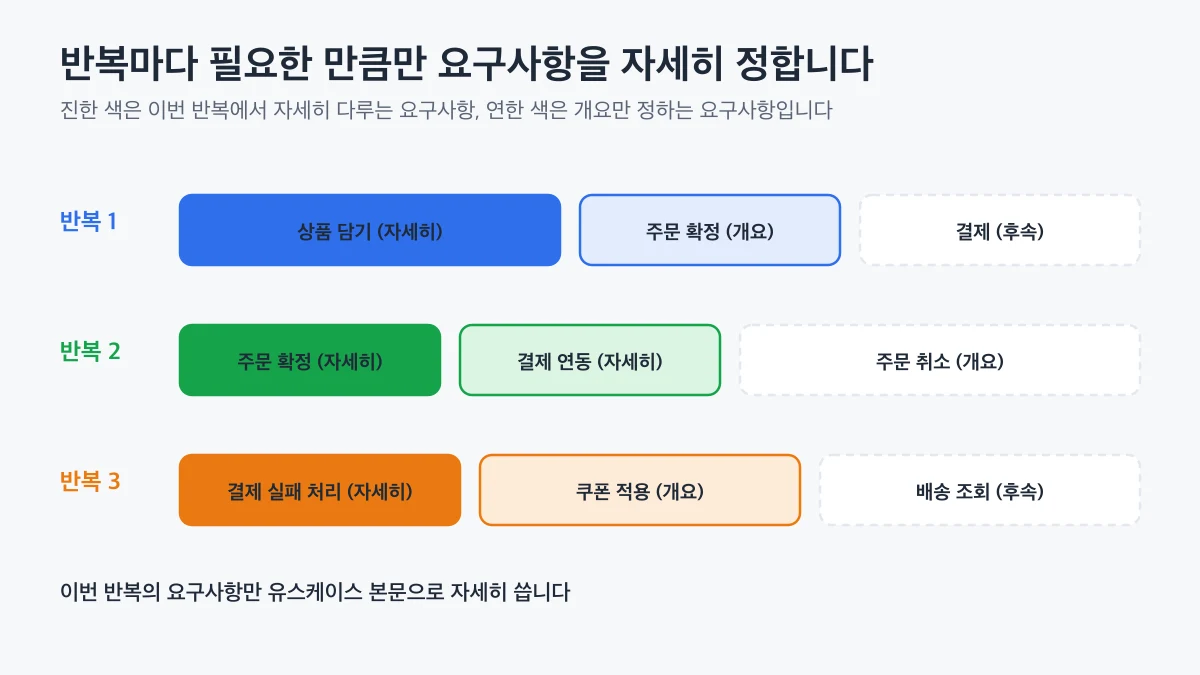
At first only the feature list and the core use cases are fixed, and as iterations progress, the parts that are needed get written in detail.
In iterative design, requirements are
not completed at once, but refined in each iteration as much as needed
.
This does not mean the requirements are incomplete.
Fixing details that do not affect the current design in advance only adds work that gets thrown away when they change later.
In each of three iterations, the requirements treated in detail are shown in dark color, while requirements shown in light color or with dashed outlines are deferred to later iterations
Priority decides which requirements are detailed in each iteration.
Priority should not rest on a single criterion, and it is safer to look at several together.
Criterion
Question
Example
Business value
Does the service fail without this feature
Add to cart, confirm order
Risk
Is there a high chance of technical failure
External payment integration
Architecture impact
Does it significantly change the structure of other features
User authentication method
Likelihood of change
Is the customer likely to change it soon
Discount policy
Requirements with large risk or architecture impact should be handled in earlier iterations, even if their business value is a little lower.
If they are discovered later, they shake the design that has already been built.
Steps for refining requirements in each iteration 🔗
When you start an iteration, refine the requirements in the following order.
Set the goal of the iteration in one sentence. For example, "the basic flow of adding products to a cart and confirming the order works."
Choose the use cases needed to reach the goal.
Write the main flow and alternative flows of the chosen use cases
in detail
.
Keep only the names and outlines of the remaining requirements, and pass them to the next iteration.
Following these steps makes the scope of each iteration clear and keeps the requirements document balanced overall.
It is natural for requirements to change during an iteration.
What matters is recording who changed what, when, and why.
👍
When you revise a requirement that was fixed in an earlier iteration, write down the reason for the change and the use cases it affects.
A requirement changed without a record becomes a subject of argument again in the next iteration.
When you apply a change, it is also important to check priorities again.
If the changed requirement has large risk or architecture impact, it is better to set the goal of the next iteration anew.
not a document that is completed from the start, but a living list that becomes more detailed with each iteration
.
Priorities are set by considering business value, risk, architecture impact, and likelihood of change together.
Detailing only the use cases the iteration's goal needs, and leaving the rest as outlines, keeps the part of the design affected by requirement changes small.
 Requirements for Iterative Design - Selecting and Refining by Iteration