When evaluating a new tool, the first thing people look at is the official demo.
But demos usually pick only the scenes where the tool does best.
So when you watch a demo, look first at
what evidence made people trust the result
, rather than the result itself.
The official REA site has three showcases.
They are DX-Ball, a 1996 Windows game; the Notion desktop app, built with Electron; and Touhou TH04, a DOS game for the PC-98.
This part reads each case in the order of
the question, the evidence REA provided, the verification method, and the remaining limits
.
🖐️
All figures and code excerpts in this post were read and transcribed on November 23, 2026 from the official REA showcases↗ and the material published in each reconstruction repository.
I did not analyze the original games or the Notion app myself.
The only thing I ran myself was recomputing, in Python, the byte values and formulas published in the showcases, and that part is marked separately in the text.
The goal of the DX-Ball showcase↗ is to rebuild DX-Ball 1.07, a 1996 Windows game, as maintainable C code.
One function from that work is presented as the case study.
It is the calculation that turns the horizontal position of a brick, when it breaks, into the left-right position of the sound (pan).
The target function's address is 0x406400.
The first pseudocode it got back looked like this.
It looks like a function with no input and no calculation, calling only one conversion function, __ftol().
But the instruction listing in the same result had code that read an input from the stack and did floating-point operations.
The showcase explains that
the pseudocode and the instructions telling different stories was the reason to keep investigating
The agent answered three questions with REA tools.
Finding the missing input
Looking at 0x406400 again with analyze_function showed it reading an integer from [EBP + 0x8] and loading it into a floating-point register with FILD.
Finding what the input means
Looking at the caller, 0x411f40, showed it passing tile_x multiplied by 30 plus 20.
In other words, the input is the brick's screen x coordinate, 20 + 30 × tile_x.
Reading the constants
Reading the bytes at 0x420068, 0x420070, and 0x4210a0 with read_bytes gave the values 1.5625, 500.0, and 1.0.
The instructions use these values to
multiply, subtract, multiply again
, and then convert to an integer.
Translating that into C gives the following function.
재구현한 C (쇼케이스 발췌)
DxBallInt dxball_screen_pan(DxBallInt x){ double pan; pan = (double)x; pan = pan * 1.5625; pan = pan - 500.0; pan = pan * dxball_pan_scale; return (DxBallInt)pan;}
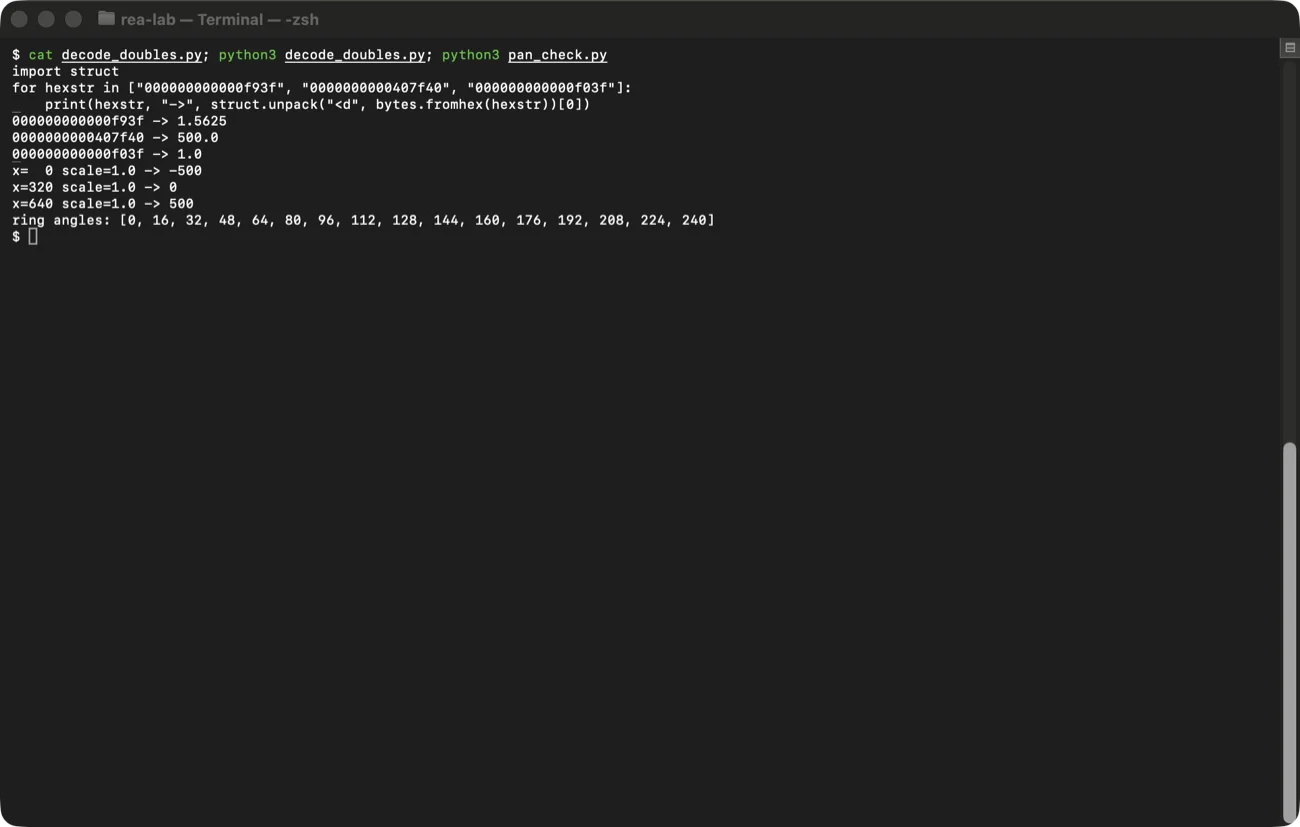
I used Python to check whether the bytes the showcase published really are those values, and whether the formula maps screen coordinates to the range -500 to 500.
x86 is little-endian, so the 8 bytes are interpreted as a double with the <d format.
# DX-Ball 쇼케이스에 공개된 식 (x*1.5625 - 500.0) * scale 을 그대로 계산for x in (0, 320, 640): print(f"x={x:3d} scale=1.0 -> {int((x * 1.5625 - 500.0) * 1.0)}") # TH04 쇼케이스의 링 간격: index*256/count (count=16)print("ring angles:", [i * 256 // 16 for i in range(16)])
Output of decode_doubles.py: 000000000000f93f is 1.5625, 0000000000407f40 is 500.0, 000000000000f03f is 1.0; output of pan_check.py: x=0 gives -500, x=320 gives 0, x=640 gives 500, and ring angles go from 0 to 240 in steps of 16
The three byte strings matched the published values, and at a scale of 1 the left edge 0 became -500, the center 320 became 0, and the right edge 640 became 500.
That also matches the showcase text.
Note, however, that this calculation only checks
that the published values are consistent with each other
Actually run the original x86 function and compare return values with the C function, for every integer position 0 to 640 × five scales (0, 0.5, 1, 20, -1)
3,205 cases match
Byte comparison
Recompile the C function with the period compiler (VC4.0) and compare with the original function bytes
All 63 bytes match
641 positions times 5 scales gives 3,205 cases.
According to the showcase, as of October 7, 2026 the whole project had 55 maintained C functions, 45,380 comparisons with the original, and 33 functions whose compiled bytes match.
The REA version used for analysis is recorded as 4.1.0.
The game is not yet playable as a whole, and it says ball and paddle physics, power-up handling, and Windows integration work remain.
The Notion showcase↗ is an Electron app analysis case.
The target is Notion Desktop 7.6.1, and the question is this.
When you copy from a page, through what path do the text and HTML get into the operating system clipboard?
The Electron structure explained in part 2 applies directly.
The UI (renderer) cannot use operating system features directly, so it sends requests to the main process through the API handed over by preload.
Running analyze_javascript_application on the tab preload file, REA returned two places to start reading inside the minified bundle, with location information.
API exposed to the page
__electronApi, line 1, columns 22764 to 22828 of preload.js
IPC call from the renderer
The invoke operation, line 1, columns 6486 to 6522 of preload.js
Because the bundle is minified into a single line, positions come out as column numbers.
The agent opened these locations, found the clipboard member, and got the channel name notion:clipboard:write from its call site.
it writes to the clipboard only after checking the sender
.
The official Electron sample in part 4 had no IPC at all, but in a real app wrappers are layered on both the preload and main sides like this, so a single channel name becomes the key that ties the two bundles together.
Preserving block structure
The copied HTML carries an ID in a notionvc comment, and the block data is saved locally under the same ID.
When pasting, a matching ID restores the block structure.
Offline SQLite connection
When the renderer requests getSqliteMeta over IPC, main creates a message channel and gives one port to the renderer and the other to a SQLite utility process.
It explains that later queries travel over that port, so tracing only the first IPC request misses the rest of the conversation.
The TH04 showcase↗ deals with the oldest target.
It is MAIN.EXE (156,258 bytes, DOS MZ format), the 16-bit executable of a DOS game for the PC-98.
The question is
how the direction of each bullet is decided when a boss fires a ring of bullets aimed at the player
.
According to the showcase, this attack initially requests a ring of 16 bullets.
The agent first checked that the executable had been loaded correctly, and only then read the code.
It opened the target with open_binary and checked the load image with inspect_native_load_image.
The result was verified, format dos-mz, load segment 4096 (0x1000).
It read the function at 0x2cfc8 with analyze_function.
This is the function that sets each bullet's velocity and angle.
The calculation read from the instructions is as follows.
Multiply the bullet index (SI) by 256 with SHL AX, 0x8 and divide by the bullet count.
Call a direction function (CALLF 0x1000:1da8) with the coordinate difference between the player and the firing position, and add its result.
Add the pattern's rotation and store only the low byte.
TH04 represents a full turn as 256 units.
So storing it in one byte naturally wraps values above 255 back around from 0, and with 16 bullets each one is 16 units apart.
The last line of the Python output above, 0, 16, 32, …, 240, is that spacing recomputed.
읽기 쉽게 요약한 C++ (쇼케이스 발췌)
unsigned char aimed_ring_angle( int index, int count, int player_direction, unsigned char rotation){ int angle = index; angle = (angle * 256) / count; angle += player_direction; angle += rotation; return (unsigned char)angle;}
As with DX-Ball, verification used compiler replay.
It says that compiling the maintained bullet-generation code with the period compiler, Turbo C++ 4.0J, matches a 2,139-byte section of the original executable, and that two clean builds produced the same bytes.
The compiler checks are recorded as October 3, 2026, and the REA code inspection as October 7 with REA 4.1.0.
The showcase also discloses that these 2,139 bytes are
the whole bullet-generation code section that contains the function, not this one function alone
, and that confirming the original game dump is a pristine original is still an open question.
It also explains that readable names such as function names come from the existing reconstruction project's source, and REA's role was to check the original operations behind those names.
Public cases show what a tool can do, but generalizing them as they are is a problem.
They are all material made by the project itself.
I did not find, in this research, any material showing an independent third party reproducing the same results.
The targets are small and old.
One function in a 1990s game and one IPC path in an Electron app are a different scale from today's large software.
They had help from existing reconstruction projects.
TH04 used the names and structure of existing reconstruction source, and DX-Ball is also in progress in a separate reconstruction repository.
The recorded REA version is 4.1.0.
That is a big version gap from the 6.10.1 used in this series.
👍
Summarizing the three cases as "REA restored games and apps" is not accurate.
More precisely, "evidence was gathered with REA to recover a few functions, and people verified them with tests and compiler replay."
 Dissecting REA Showcases - DX-Ball, Notion and Touhou TH04